
 +
+
 By
By Sundarbans National Park – History, Biodiversity & Local Life
The Sundarbans is the world’s largest mangrove forest and delta, formed by the Ganga, Brahmaputra, and Meghna rivers. Famous for the Royal Bengal Tiger, it is a UNESCO World Heritage Site known for its rich biodiversity and unique ecosystem.
About Sundarban National Park
The Sundarbans is the world’s largest mangrove forest and one of India’s greatest natural treasures. It covers nearly 10,000 sq. km. across India and Bangladesh and lies in the delta formed by the Ganga, Brahmaputra, and Meghna rivers.
The forest supports more than 60 mangrove species, over 300 bird species, and a wide variety of reptiles, amphibians, estuarine fish, and mammals. Visitors can spot the Royal Bengal Tiger, Fishing Cat, Spotted Deer, Saltwater Crocodile, Wild Boar, Leopard Cat, Monitor Lizard, Olive Ridley Turtle, and many other animals. Moreover, the mangrove forests protect nearby villages from cyclones, floods, and coastal erosion.
The Sundarbans has a rich history that dates back to the Mauryan period. Over the centuries, agriculture, settlements, and deforestation transformed the landscape. As a result, governments introduced several conservation measures to protect its unique ecosystem.
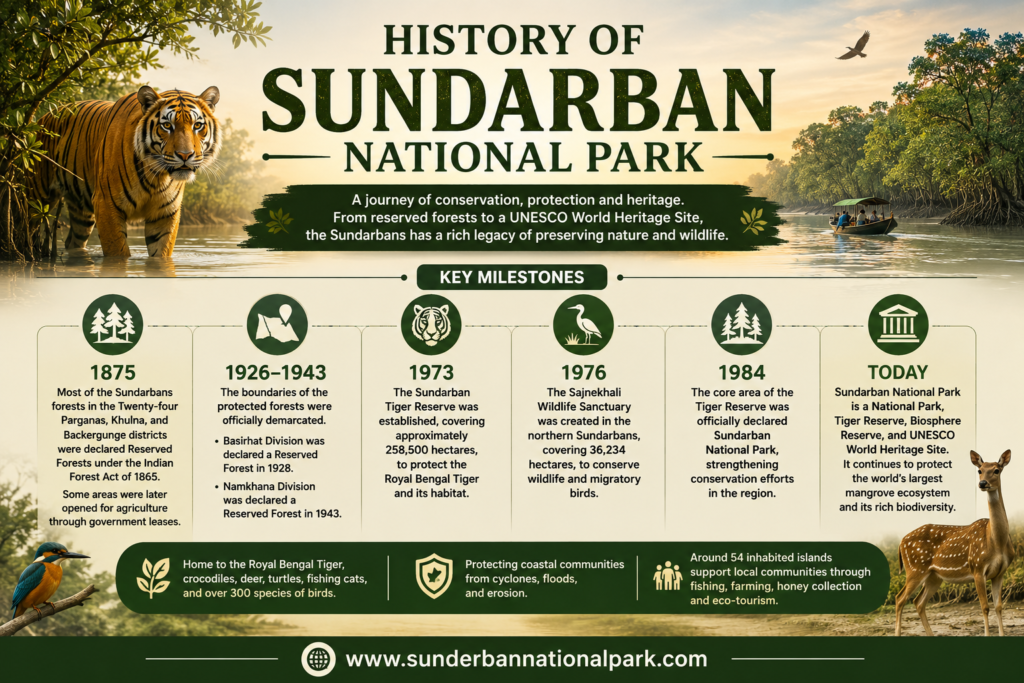
Conservation Timeline
- 1875: Authorities declared large parts of the Sundarbans in the Twenty-four Parganas, Khulna, and Backergunge districts as Reserved Forests under the Indian Forest Act.
- 1926–1943: Officials defined the forest boundaries. They declared the Basirhat Division a Reserved Forest in 1928 and the Namkhana Division in 1943.
- 1973: The Government of India created the Sundarban Tiger Reserve to protect the Royal Bengal Tiger and its habitat.
- 1976: Authorities established the Sajnekhali Wildlife Sanctuary to conserve wildlife and migratory birds.
- 1984: The Government officially declared the core area Sundarban National Park, strengthening conservation efforts.
Today, the Sundarbans enjoys the status of a National Park, Tiger Reserve, Biosphere Reserve, and UNESCO World Heritage Site. These recognitions highlight its global ecological importance.
Around 54 islands in the Indian Sundarbans have permanent settlements. Local communities depend on fishing, farming, honey collection, and tourism for their livelihood. However, they continue to face challenges such as cyclones, salinity, and human-wildlife conflict.
The best time to visit Sundarban National Park is from September to May. During this season, visitors enjoy exciting boat safaris through rivers and mangrove creeks. They also explore watchtowers, observe diverse wildlife, and experience the culture of local villages. Therefore, a Sundarban tour offers the perfect combination of wildlife, adventure, nature, and eco-tourism.